


OSHA Top 10 Violations: 2026 vs. 2025 — What Changed?
OSHA's preliminary FY2026 Top 10 violations reveal where workplace safety compliance challenges persist and which standards have shifted since 2025. Explore the year-over-year rankings, including fall protection, lockout/tagout, scaffolding, and respiratory protection, and discover what construction and manufacturing safety leaders should consider when reviewing training, equipment, and workplace safety programs.
OSHA's Top 10 Violations for 2026: What Changed From 2025?
OSHA's preliminary FY2026 Top 10 most frequently cited workplace safety violations reveal familiar compliance challenges—and some notable changes from 2025.
Fall Protection remains the most frequently cited violation, while Lockout/Tagout and Scaffolding have moved higher in the rankings. These shifts provide an opportunity for construction and manufacturing safety leaders to evaluate their safety programs, identify potential compliance gaps, and reinforce workplace hazard prevention.
In this article, we'll compare OSHA's 2026 and 2025 Top 10 violations, highlight the most significant ranking changes, and explore practical steps employers can take to strengthen workplace safety.
We'll also examine how appropriate PPE, employee training, safety assessments, and compliance services can help organizations address common workplace hazards.
OSHA's Top 10 Most Cited Violations — Year-over-Year Comparison
The preliminary FY2026 rankings show that many of the same workplace safety standards continue to present compliance challenges for employers. Fall Protection and Hazard Communication remain in the top two positions, while Lockout/Tagout, Scaffolding, and Ladders have changed positions.
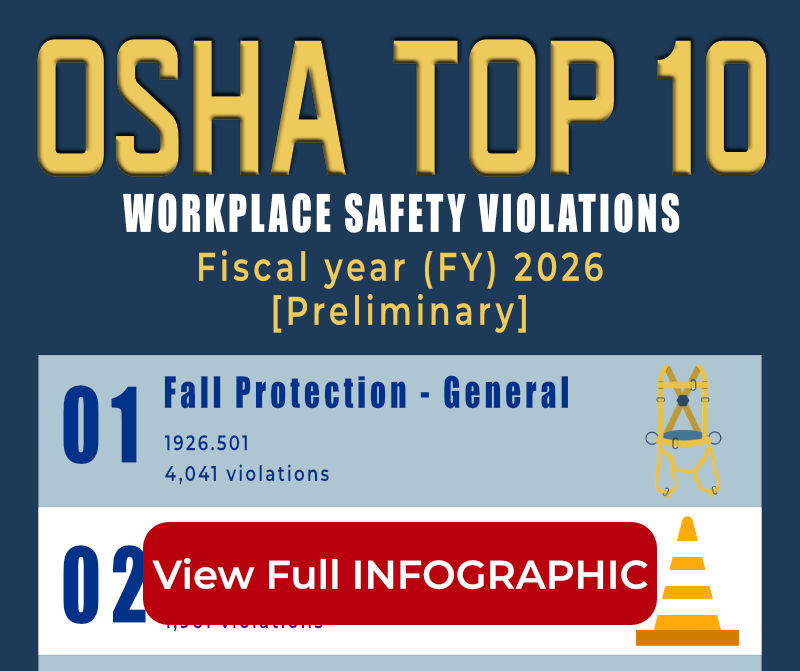
| OSHA Standard | FY2025 Final Rank | FY2026 Preliminary Rank |
|---|---|---|
| Fall Protection – General Requirements | 1 | 1 |
| Hazard Communication | 2 | 2 |
| Lockout/Tagout | 4 | 3 |
| Scaffolding | 6 | 4 |
| Ladders | 3 | 5 |
| Respiratory Protection | 5 | 6 |
| Powered Industrial Trucks | 8 | 7 |
| Fall Protection – Training | 7 | 8 |
| Eye and Face Protection | 9 | 9 |
| Machine Guarding | 10 | 10 |
What Do the Ranking Changes Tell Us?
The most notable movement in OSHA's preliminary FY2026 Top 10 involves Scaffolding, Lockout/Tagout, and Ladders.
-
Scaffolding rose from #6 to #4, highlighting the continued importance of safe access, properly maintained equipment, and worker training.
-
Lockout/Tagout moved from #4 to #3, reinforcing the need for effective hazardous energy control procedures.
-
Ladders dropped from #3 to #5, although ladder safety remains an important consideration for construction employers.
-
Fall Protection remains #1, underscoring the ongoing need for fall hazard assessments, appropriate protective equipment, and employee training.
These rankings reflect the frequency of OSHA citations—not necessarily changes in the underlying severity of workplace hazards. Employers should use the findings alongside their own hazard assessments, incident records, and operational requirements when establishing safety priorities.
What Should Safety Leaders Prioritize in 2026?
OSHA's preliminary FY2026 Top 10 violations reinforce an important message: Many of the workplace safety challenges employers face today are the same hazards that appear in OSHA's rankings year after year.
Although some standards have shifted positions, Fall Protection remains the most frequently cited violation. Lockout/Tagout, Scaffolding, Respiratory Protection, and other familiar compliance concerns continue to warrant attention.
For construction and manufacturing employers, these findings provide an opportunity to review:
-
Fall Protection Programs: Evaluate fall hazards, equipment selection, inspections, and employee training.
-
Lockout/Tagout Procedures: Confirm hazardous energy control procedures are current and employees understand their responsibilities.
-
Workplace Safety Training: Reinforce safe work practices and address gaps identified through assessments and observations.
-
PPE and Respiratory Protection: Review equipment suitability, maintenance, and applicable training requirements.
-
Safety Audits and Assessments: Identify potential hazards and opportunities to strengthen existing safety programs.
The goal isn't simply to avoid citations. It's to prevent incidents, protect employees, and build safer workplaces.
Strengthen Your Workplace Safety Program With Advanced Safety Supply
Understanding OSHA's most frequently cited standards is an important first step. Taking action is what makes the difference.
Advanced Safety & Industrial Supply supports construction, manufacturing, and industrial operations with workplace safety equipment, personal protective equipment, training, and specialized safety services.
Whether your organization needs fall protection equipment, respiratory protection, Lockout/Tagout solutions, or assistance evaluating workplace safety requirements, our team can help you identify the appropriate next steps.
Don't wait for an inspection to uncover a safety gap.
Contact Advanced Safety Supply to discuss your workplace safety needs, request a quote, or explore our safety services.


